
Showing posts with label Maha Kumbha 2013. Show all posts
Showing posts with label Maha Kumbha 2013. Show all posts
There was a time when pilgrimages were not for comfort-loving travellers. But with the advent of modern transportation and the hospitality industry, seeking salvation has become a much easier mission today, provided you have a decent kitty to enjoy those expensive options. Starting with helicopter services to temples tucked away in the mighty Himalayas and in southern India, e-donations and e-prasad and e-aarti, the salvation journey has become much more comfortable too.
So we were hardly surprised to read that the 2013 edition of the Kumbh Mela will also get a healthy dose of such worldly comforts and pleasures. According to a news report, the 2013 edition of the world famous spiritual jamboree, when at least eight crore people are expected to land up in Allahabad in Uttar Pradesh, will also have a few hundred Swiss cottages for weary and rich participants. These cottages will be equipped with geysers, toilets and all other amenities that a hotel would usually provide. The snug tents will cost around Rs. 6,000 per night and they would be located barely a few metres from the confluence of three rivers - all that the pilgrims will have to do is walk out of their luxury spaces to take that all-important dip. And therein lies a wonderful, delicious irony: even after paying so much for comfort and exclusivity, the residents of the Swiss tents would still have to take a dip in the same river, along with the same unwashed masses that they are so keen to avoid.
That's not all; the cocooned brigade will miss out on everything that the Kumbh Mela is known for: different kinds of people from all across the world, round-the-clock action and a riot of colour and ideas - some absolutely vague but entertaining nonetheless. The best part is that the mega mela still retains a lot of its old-world charm. It has never been packaged like, for example, the Diamond Jubilee of Queen Elizabeth II, but it still manages to attract thousands of people from across the world. And missing out on all that fun will be absolutely sacrilegious.

Occupy Kumbh Mela
Kumbha 2013 +
kumbha mela +
Maha Kumbh Mela 2013 +
Maha Kumbha 2013
There was a time when pilgrimages were not for comfort-loving travellers. But with the advent of modern transportation and the hospitality industry, seeking salvation has become a much easier mission today, provided you have a decent kitty to enjoy those expensive options. Starting with helicopter services to temples tucked away in the mighty Himalayas and in southern India, e-donations and e-prasad and e-aarti, the salvation journey has become much more comfortable too.
So we were hardly surprised to read that the 2013 edition of the Kumbh Mela will also get a healthy dose of such worldly comforts and pleasures. According to a news report, the 2013 edition of the world famous spiritual jamboree, when at least eight crore people are expected to land up in Allahabad in Uttar Pradesh, will also have a few hundred Swiss cottages for weary and rich participants. These cottages will be equipped with geysers, toilets and all other amenities that a hotel would usually provide. The snug tents will cost around Rs. 6,000 per night and they would be located barely a few metres from the confluence of three rivers - all that the pilgrims will have to do is walk out of their luxury spaces to take that all-important dip. And therein lies a wonderful, delicious irony: even after paying so much for comfort and exclusivity, the residents of the Swiss tents would still have to take a dip in the same river, along with the same unwashed masses that they are so keen to avoid.
That's not all; the cocooned brigade will miss out on everything that the Kumbh Mela is known for: different kinds of people from all across the world, round-the-clock action and a riot of colour and ideas - some absolutely vague but entertaining nonetheless. The best part is that the mega mela still retains a lot of its old-world charm. It has never been packaged like, for example, the Diamond Jubilee of Queen Elizabeth II, but it still manages to attract thousands of people from across the world. And missing out on all that fun will be absolutely sacrilegious.
A unexpected issues comes from Juna Akhara, when Radhe Maa’s was appointed as Mahamandaleshwar. Only 5 months left for historical festival Maha Kumbha but why this step taken by Acharya Mahamandaleshwar and famous Mahamandaleshwar Avdheshanand Giri Ji Maharaj of Juna Akhara?
So Radhe Maa's has been suspended from the prestigious post of Mahamandalehwar in Haridwar's famous 'Juna Akhada'. The religious seer will be suspended till such time the probe regarding her nomination to the post is probed.
The entire episode revolving arund Radhe Maa began when she was suddenly appointed the Mahamandaleshwar of Juna Akhada. The sudden development raised many questions. The allegation has been levelled that The Juna Akhada gave her the post after paying her a fat amount.
On Tuesday evening, Radhe Maa went to Haridwar in a clandestine fashion. At night she was appointed as Mahamandaleshwar. The honours were performed by Acharya Mandaleshwar and famous saint Avdheshanand Giri.
Now a Investigation team of 11 Sants has been setup for investigation of this drama from Juna Akhara. But the question is, Why first they appoint as a Mahamandleshwar and next day she suspend? What politics is going on? We never know the truth. But what will happen in Maha Kumbh we will see in Maha Kumbha 2013.
So please stay with us and regularly watch update of this blog.

Radhe Maa
Radhe Maa suspended from Mahamandaleshwar
akhara +
Juna Akhara +
Maha Kumbha 2013 +
Radhe Maa
A unexpected issues comes from Juna Akhara, when Radhe Maa’s was appointed as Mahamandaleshwar. Only 5 months left for historical festival Maha Kumbha but why this step taken by Acharya Mahamandaleshwar and famous Mahamandaleshwar Avdheshanand Giri Ji Maharaj of Juna Akhara?
So Radhe Maa's has been suspended from the prestigious post of Mahamandalehwar in Haridwar's famous 'Juna Akhada'. The religious seer will be suspended till such time the probe regarding her nomination to the post is probed.
The entire episode revolving arund Radhe Maa began when she was suddenly appointed the Mahamandaleshwar of Juna Akhada. The sudden development raised many questions. The allegation has been levelled that The Juna Akhada gave her the post after paying her a fat amount.
On Tuesday evening, Radhe Maa went to Haridwar in a clandestine fashion. At night she was appointed as Mahamandaleshwar. The honours were performed by Acharya Mandaleshwar and famous saint Avdheshanand Giri.
Now a Investigation team of 11 Sants has been setup for investigation of this drama from Juna Akhara. But the question is, Why first they appoint as a Mahamandleshwar and next day she suspend? What politics is going on? We never know the truth. But what will happen in Maha Kumbh we will see in Maha Kumbha 2013.
So please stay with us and regularly watch update of this blog.
|
| Radhe Maa |
In Hinduism, sadhu ( “good man, holy man”) denotes an ascetic, wandering monk. Although the vast majority of sadhus are yogis, not all yogis are sadhus. The sadhu is solely dedicated to achieving moksa (liberation), the fourth and final asrama (stage of life), through meditation and contemplation of brahman. Sadhus often wear ochre-colored clothing, symbolizing their sanyasa (renunciation). This way of life is open to women; the female form of the word is sadhvi. Sadhus are sanyasi, or renunciation, who have left behind all material and sexual attachments and live in caves, forests and temples all over World.
Kumbh Mela or the Kumbh festival invites millions of tourist, pilgrims and foreign national to be the part of this glory of history that hindu religion has to offer human kind. However, not only kumbh festival the major crowd puller to this religious event are Sadhus and Naga baba. These naga baba attracts the attention of all due to their rare appearance and their extra ordinary rituals.
Travelers from round the globe drop in to be a part of Kumbh Mela or Kumbh festival inorder to have a glance of these Naga sadhus meditate and perform the weird religious and spiritual activities. Naga Sadhus belongs to different Akharas (which means camps) and each akharash have their own set of Naga Babas who are living this world in most unconventional way and follow their own set of religion and spiritual activities without caring about this world.
The identification feature of Naga Sadhus include being naked with long hairs knotted with different metals and body smeared with ashes. Not only this, one can see Naga Sadhus could be seen wearing beads of Rudraksha, believe to posses positive healing power according to Hindu mythology. Not just a few but you can witness Naga sadhus wearing thousand of Rudraksha beads and is believed that wearing Eleven thousand Rudrakhsa beads will help them attain the form of Lord Shankara or Lord Shiva.


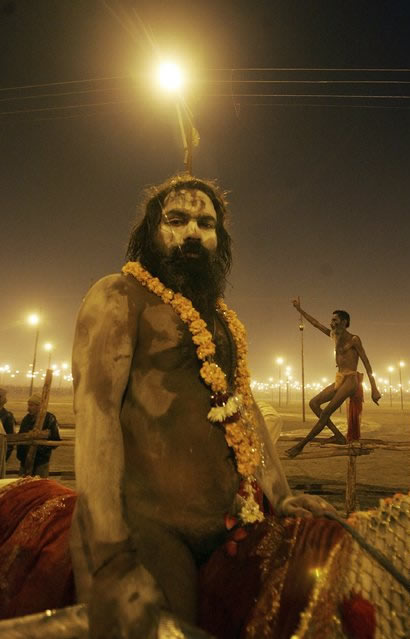


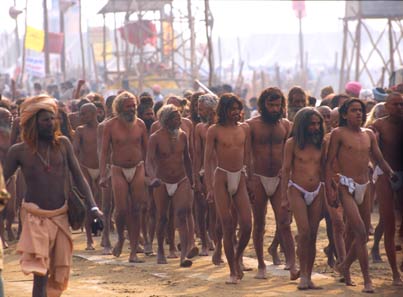


Nagas Sadhus (Baba)
Kumbh Mela +
kumbh mela 2013 +
Maha Kumbha 2013 +
Naga Sadhus
In Hinduism, sadhu ( “good man, holy man”) denotes an ascetic, wandering monk. Although the vast majority of sadhus are yogis, not all yogis are sadhus. The sadhu is solely dedicated to achieving moksa (liberation), the fourth and final asrama (stage of life), through meditation and contemplation of brahman. Sadhus often wear ochre-colored clothing, symbolizing their sanyasa (renunciation). This way of life is open to women; the female form of the word is sadhvi. Sadhus are sanyasi, or renunciation, who have left behind all material and sexual attachments and live in caves, forests and temples all over World.
Kumbh Mela or the Kumbh festival invites millions of tourist, pilgrims and foreign national to be the part of this glory of history that hindu religion has to offer human kind. However, not only kumbh festival the major crowd puller to this religious event are Sadhus and Naga baba. These naga baba attracts the attention of all due to their rare appearance and their extra ordinary rituals.
Travelers from round the globe drop in to be a part of Kumbh Mela or Kumbh festival inorder to have a glance of these Naga sadhus meditate and perform the weird religious and spiritual activities. Naga Sadhus belongs to different Akharas (which means camps) and each akharash have their own set of Naga Babas who are living this world in most unconventional way and follow their own set of religion and spiritual activities without caring about this world.
The identification feature of Naga Sadhus include being naked with long hairs knotted with different metals and body smeared with ashes. Not only this, one can see Naga Sadhus could be seen wearing beads of Rudraksha, believe to posses positive healing power according to Hindu mythology. Not just a few but you can witness Naga sadhus wearing thousand of Rudraksha beads and is believed that wearing Eleven thousand Rudrakhsa beads will help them attain the form of Lord Shankara or Lord Shiva.
Adi Shankara (Sanskrit: आदि शङ्करः (788 - 820), also known as Sankara Bhagavatpadacarya and Adi Sankaracarya was an Indian philosopher from Kaladi in present day Eranakulam district, Kerala who consolidated the doctrine of advaita vedanta. His teachings are based on the unity of the atman and brahman non-dual brahman, in which brahman is viewed as nirguna brahman, brahman without attributes.
Shankara travelled across the Indian subcontinent to propagate his philosophy through discourses and debates with other thinkers. He is reputed to have founded four mathas ("monasteries"), which helped in the historical development, revival and spread of Advaita Vedanta of which he is known as the greatest revivalist. Adi Shankara is believed to be the organizer of the Dashanami monastic order and the founder of the Shanmata tradition of worship.
His works in Sanskrit concern themselves with establishing the doctrine of advaita (nondualism). He also established the importance of monastic life as sanctioned in the Upanishads and Brahma Sutra, in a time when the Mimamsa school established strict ritualism and ridiculed monasticism. Shankara represented his works as elaborating on ideas found in the Upanishads, and he wrote copious commentaries on the Vedic canon (Brahma Sutra, principal upanishads and Bhagavad Gita) in support of his thesis. The main opponent in his work is the Mimamsa school of thought, though he also offers arguments against the views of some other schools like Samkhya and certain schools of Buddhism.


 Below:PHOTOS OF PRESENT JAGADGURU SHANKARACHARYAS
1) Jagadguru Shankaracharya Shri Swami Swaroopananda Saraswati ji Maharaj of Dwarka Sharada and Badri Jyotish Peetham (at present holding two peethams)
2) Jagadguru Shankaracharya Shri Swami Nishchalananda Saraswati ji Maharaj of Puri Shri Govardhan Peetham.
3) Jagadguru Shankaracharya Shri Swami Bharati Teertha ji Maharaj of Sringeri Shri Sharada Peetham.


Source:
http://www.sringeri.net/
http://www.shrimata.com/
http://trueeventindia.com
Maha Kumbha : About Adi Shankarachayrya
Kumbh 2013 +
Kumbha +
Kumbha 2013 +
kumbha mela +
Maha Kumbha 2013 +
Maha Kumbha Mela
Adi Shankara (Sanskrit: आदि शङ्करः (788 - 820), also known as Sankara Bhagavatpadacarya and Adi Sankaracarya was an Indian philosopher from Kaladi in present day Eranakulam district, Kerala who consolidated the doctrine of advaita vedanta. His teachings are based on the unity of the atman and brahman non-dual brahman, in which brahman is viewed as nirguna brahman, brahman without attributes.
Shankara travelled across the Indian subcontinent to propagate his philosophy through discourses and debates with other thinkers. He is reputed to have founded four mathas ("monasteries"), which helped in the historical development, revival and spread of Advaita Vedanta of which he is known as the greatest revivalist. Adi Shankara is believed to be the organizer of the Dashanami monastic order and the founder of the Shanmata tradition of worship.
His works in Sanskrit concern themselves with establishing the doctrine of advaita (nondualism). He also established the importance of monastic life as sanctioned in the Upanishads and Brahma Sutra, in a time when the Mimamsa school established strict ritualism and ridiculed monasticism. Shankara represented his works as elaborating on ideas found in the Upanishads, and he wrote copious commentaries on the Vedic canon (Brahma Sutra, principal upanishads and Bhagavad Gita) in support of his thesis. The main opponent in his work is the Mimamsa school of thought, though he also offers arguments against the views of some other schools like Samkhya and certain schools of Buddhism.
Below:PHOTOS OF PRESENT JAGADGURU SHANKARACHARYAS
1) Jagadguru Shankaracharya Shri Swami Swaroopananda Saraswati ji Maharaj of Dwarka Sharada and Badri Jyotish Peetham (at present holding two peethams)
2) Jagadguru Shankaracharya Shri Swami Nishchalananda Saraswati ji Maharaj of Puri Shri Govardhan Peetham.
3) Jagadguru Shankaracharya Shri Swami Bharati Teertha ji Maharaj of Sringeri Shri Sharada Peetham.
Source:
http://www.sringeri.net/http://www.shrimata.com/
http://trueeventindia.com
The monastic structure of Sanatana Dharma is complex and organic, most monks belong to a parampara (lineage) or a monastic order. The Akhara vary in theology as well as size and influence; most are Smarta in practice, but three are considered Vaishnavite and a few are Saivite. There is plenty of respectful acceptances for different points of view among the groups and no dominance exists. Other large exist outside the Akharas, such as the Swaminarayan fellowship, the RamaKrishna Order and the Nathas of South India. Within each Akhara, most sannyasins are also associated with one of the dashanami lineages. Adi Shankara, who originated the dashanami system and did much to revitalize and improve the system of monastic orders.
Sadhus are in two broad categories, those who love in monastic communities and those who wander or live in solitude. The socially engaged Juna Akhara (The Juna Akhara is the largest of the thirteen akharas consisting of over 500,000 sadhus and five million sanyassis) consists of both types and is host to thousands of naga sadhus and maunis who strive to uplift the world by their silent existence, anonymously blessing society from secluded caves. Their lack of involvement maintains certain fluidity in the monastic order; these outlying branches of the family prevent the Acharya from becoming too central to the structure. During the monumental Kumbha Melas, the mountain dwelling Sadhus join their brothers of the same Akhara in a surprisingly harmonious weave, populating vast areas under colorful tents and new sannyasins are initiated by the Acharaya Mahamandaleshwar, usually by the thousands in a powerful event.
Literally, "Mahamandaleshwar" means "Superior of great and/or numerous monasteries" or "Superior of a religious district or province" (maha = great, mandala = district, ishwara = head, sovereign). There are two systems of organization in the dashanami order. Each of the ten names (dasha = ten, nami = name), which is appended to a monk's given name at initiation, is assigned to one of the four cardinal monastic seats founded by Shankaracharya and presided over by his direct successors at Joshimath in North India, Dwarka in the West, Shringeri in the South and Puri in the East.
The other system is the akhara system of which the Mahamandaleshwaras are a part. Their origin dates from the early days of Islamic invasions into India (around or just prior to 1000 CE) when many monks became the targets of murderous attacks. In order to protect themselves, they formed "regiments" of monk-warriors who, to this day, preserve the traditional martial arts of India in addition to their spiritual practices. So in addition to being a way to organize the orders at a local level they have historically also served as paramilitary regiments with the Mahamandaleshwaras as generals, as it were, of these regiments.

Mahamandaleshwar Swami Kumaranand Saraswati Ji Maharaj

Acharya Mahamandaleshwar Yugpurush Swami Paramanand Ji Maharaj

Barbara Marx Hubbard

Mahamandaleshwar Swami Nityananda


Mahamandaleshwar Swami Vishnu Devananda Giri Maharaj


Mahamandaleshwar H H SriSwami Satyamitranandaji Maharaj

Mahamandaleshwar Shaktiananda Ma Lattin America

Mahamandaleshwar Swami Shankarananda

Mahamandaleshwar Swami Swarupananda Western Church of Sanatana Dharma founded in 2008

Michael Murphy

Rothko Chapel
Maha Kumbha 2013 : About Mahamandelshwar
Kumbh 2013 +
Kumbha +
Kumbha 2013 +
kumbha mela +
Maha Kumbha 2013 +
Maha Kumbha Mela
The monastic structure of Sanatana Dharma is complex and organic, most monks belong to a parampara (lineage) or a monastic order. The Akhara vary in theology as well as size and influence; most are Smarta in practice, but three are considered Vaishnavite and a few are Saivite. There is plenty of respectful acceptances for different points of view among the groups and no dominance exists. Other large exist outside the Akharas, such as the Swaminarayan fellowship, the RamaKrishna Order and the Nathas of South India. Within each Akhara, most sannyasins are also associated with one of the dashanami lineages. Adi Shankara, who originated the dashanami system and did much to revitalize and improve the system of monastic orders.
Sadhus are in two broad categories, those who love in monastic communities and those who wander or live in solitude. The socially engaged Juna Akhara (The Juna Akhara is the largest of the thirteen akharas consisting of over 500,000 sadhus and five million sanyassis) consists of both types and is host to thousands of naga sadhus and maunis who strive to uplift the world by their silent existence, anonymously blessing society from secluded caves. Their lack of involvement maintains certain fluidity in the monastic order; these outlying branches of the family prevent the Acharya from becoming too central to the structure. During the monumental Kumbha Melas, the mountain dwelling Sadhus join their brothers of the same Akhara in a surprisingly harmonious weave, populating vast areas under colorful tents and new sannyasins are initiated by the Acharaya Mahamandaleshwar, usually by the thousands in a powerful event.
Sadhus are in two broad categories, those who love in monastic communities and those who wander or live in solitude. The socially engaged Juna Akhara (The Juna Akhara is the largest of the thirteen akharas consisting of over 500,000 sadhus and five million sanyassis) consists of both types and is host to thousands of naga sadhus and maunis who strive to uplift the world by their silent existence, anonymously blessing society from secluded caves. Their lack of involvement maintains certain fluidity in the monastic order; these outlying branches of the family prevent the Acharya from becoming too central to the structure. During the monumental Kumbha Melas, the mountain dwelling Sadhus join their brothers of the same Akhara in a surprisingly harmonious weave, populating vast areas under colorful tents and new sannyasins are initiated by the Acharaya Mahamandaleshwar, usually by the thousands in a powerful event.
Literally, "Mahamandaleshwar" means "Superior of great and/or numerous monasteries" or "Superior of a religious district or province" (maha = great, mandala = district, ishwara = head, sovereign). There are two systems of organization in the dashanami order. Each of the ten names (dasha = ten, nami = name), which is appended to a monk's given name at initiation, is assigned to one of the four cardinal monastic seats founded by Shankaracharya and presided over by his direct successors at Joshimath in North India, Dwarka in the West, Shringeri in the South and Puri in the East.
The other system is the akhara system of which the Mahamandaleshwaras are a part. Their origin dates from the early days of Islamic invasions into India (around or just prior to 1000 CE) when many monks became the targets of murderous attacks. In order to protect themselves, they formed "regiments" of monk-warriors who, to this day, preserve the traditional martial arts of India in addition to their spiritual practices. So in addition to being a way to organize the orders at a local level they have historically also served as paramilitary regiments with the Mahamandaleshwaras as generals, as it were, of these regiments.
The other system is the akhara system of which the Mahamandaleshwaras are a part. Their origin dates from the early days of Islamic invasions into India (around or just prior to 1000 CE) when many monks became the targets of murderous attacks. In order to protect themselves, they formed "regiments" of monk-warriors who, to this day, preserve the traditional martial arts of India in addition to their spiritual practices. So in addition to being a way to organize the orders at a local level they have historically also served as paramilitary regiments with the Mahamandaleshwaras as generals, as it were, of these regiments.
|
| Mahamandaleshwar Swami Kumaranand Saraswati Ji Maharaj |
|
| Acharya Mahamandaleshwar Yugpurush Swami Paramanand Ji Maharaj |
|
| Barbara Marx Hubbard |
|
| Mahamandaleshwar Swami Nityananda |
|
| Mahamandaleshwar Swami Vishnu Devananda Giri Maharaj |
|
| Mahamandaleshwar H H SriSwami Satyamitranandaji Maharaj |
|
| Mahamandaleshwar Shaktiananda Ma Lattin America |
|
| Mahamandaleshwar Swami Shankarananda |
|
| Mahamandaleshwar Swami Swarupananda Western Church of Sanatana Dharma founded in 2008 |
|
| Michael Murphy |
|
| Rothko Chapel |
Sringeri, is a hill town and taluk headquarters located in Chikmagalur district in the Indian state of Karnataka, is the site of the first maţha established by Adi Shankaracharya, Hindu theologian and exponent of the Advaita Vedanta philosophy, in the 8th century C.E. It is located on the banks of the river Tunga. It is also referred to as Dakshinamnaya Sringeri Sharada peetam. Following the tradition initiated by Adi Shankaracharya, the maţha is incharge of the Yajur Veda (the Krishna (Black) Yajurveda is more prevalent in South India, over which the maţha has authority in the Smarta tradition).The head of the matha is called Jagadguru (teacher of the world) and also carries the Shankaracharya name as a title.

Jagadguru Shankaracharya Shri Swami Bharati Teertha ji Maharaj of Sringeri Shri Sharada Peetham

Swami Santhananda with the Sankaracharyas of Shringeri Math

Sringeri Sharadha Temple


Vidyashankara temple from bridge over Tunga, Sringeri in Karnataka

Sharada Temple at the Sringeri Adi shankacharya math in Karnataka
Maha Kumbha 2013 : Shringeri Matha
Kumbh 2013 +
Kumbha +
kumbha mela +
Maha Kumbha 2013 +
matha
Sringeri, is a hill town and taluk headquarters located in Chikmagalur district in the Indian state of Karnataka, is the site of the first maţha established by Adi Shankaracharya, Hindu theologian and exponent of the Advaita Vedanta philosophy, in the 8th century C.E. It is located on the banks of the river Tunga. It is also referred to as Dakshinamnaya Sringeri Sharada peetam. Following the tradition initiated by Adi Shankaracharya, the maţha is incharge of the Yajur Veda (the Krishna (Black) Yajurveda is more prevalent in South India, over which the maţha has authority in the Smarta tradition).The head of the matha is called Jagadguru (teacher of the world) and also carries the Shankaracharya name as a title.
|
| Jagadguru Shankaracharya Shri Swami Bharati Teertha ji Maharaj of Sringeri Shri Sharada Peetham |
|
| Swami Santhananda with the Sankaracharyas of Shringeri Math |
|
| Sringeri Sharadha Temple |
|
| Vidyashankara temple from bridge over Tunga, Sringeri in Karnataka |
|
| Sharada Temple at the Sringeri Adi shankacharya math in Karnataka |


